

Introduction
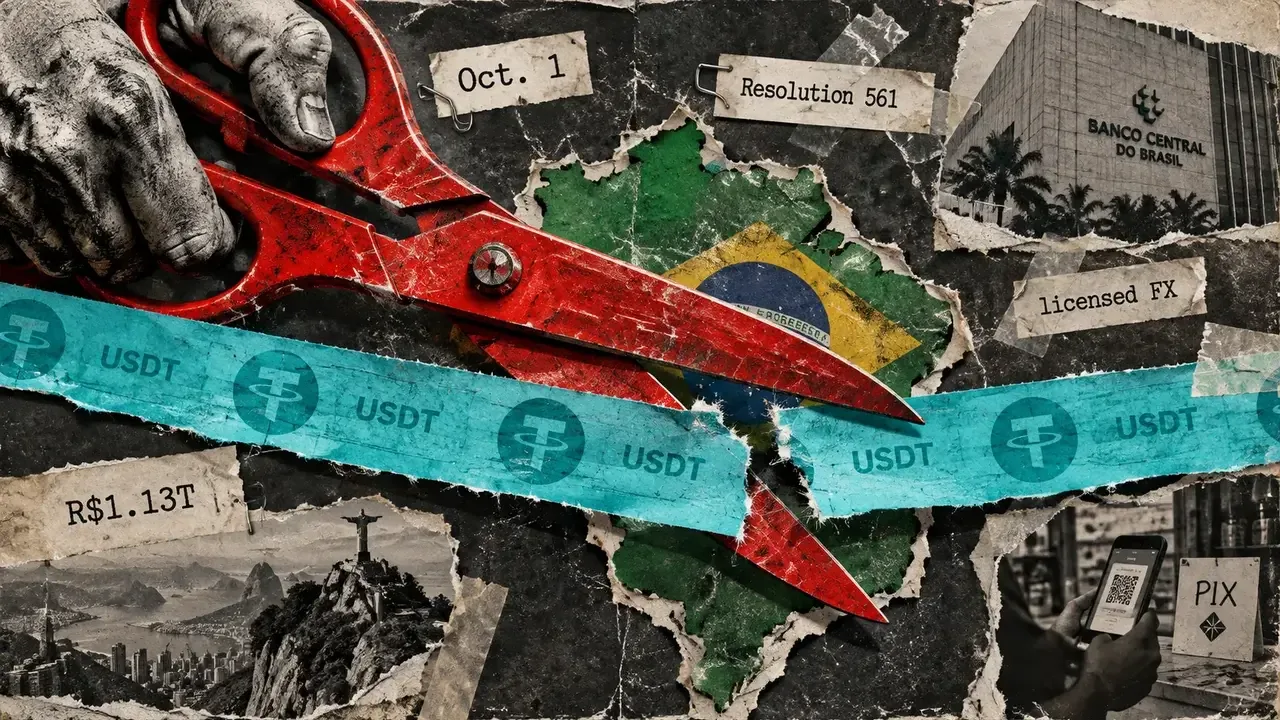
Brazil is drawing a clearer boundary between digital-asset innovation and regulated foreign-exchange settlement. Under Resolution 561, the country’s central bank will prohibit virtual assets, including stablecoins, from settling a specific category of international payment flow beginning Oct. 1.
The restriction targets the settlement leg between regulated foreign-exchange providers and their overseas counterparties. That portion of the transaction must instead be completed through a licensed FX transaction or a qualifying non-resident Brazilian real account. The measure therefore limits how stablecoins can be used within institutional cross-border payments, rather than imposing a blanket prohibition on all virtual-asset activity.
Key Points
- Resolution 561 takes effect on Oct. 1 and covers a defined international settlement channel.
- Stablecoins and other virtual assets cannot settle the regulated leg between local FX providers and foreign counterparties.
- Permitted settlement must use a licensed FX transaction or an eligible non-resident real account.
- The rule narrows stablecoin utility in Brazil’s institutional payment infrastructure while leaving other uses outside its direct scope.
Market Impact Analysis
The immediate impact is likely to be concentrated among stablecoin payment companies, foreign-exchange providers and businesses exploring digital assets for international treasury operations. Firms that planned to use stablecoins for this particular settlement leg will need to redesign their workflows, rely on conventional FX infrastructure or determine whether another legally approved structure is available.
For the wider crypto market, the signal is more regulatory than fundamentally disruptive. Stablecoins derive part of their value proposition from fast, programmable cross-border settlement, so excluding them from a major economy’s regulated FX channel may reduce institutional adoption in that use case. However, the rule does not directly affect crypto trading, custody or ownership, and it should not be interpreted as a general ban on stablecoins throughout Brazil.
The decision may also raise compliance costs for payment providers operating across multiple jurisdictions. Companies will need to separate eligible digital-asset services from regulated FX settlement, strengthen transaction monitoring and document that funds move through the required licensed channels. Smaller providers could face a heavier operational burden than larger firms with established banking relationships.
Bitcoin and ether are unlikely to experience a direct price effect because the measure does not target either asset or their underlying networks. Broader altcoin sentiment could remain cautious, however, as investors monitor whether other central banks adopt similarly restrictive interpretations of stablecoin use in foreign-exchange markets.
There is a potential long-term benefit from regulatory certainty. A defined perimeter may help compliant providers build products around approved rails instead of operating in a gray area. Nevertheless, the commercial attractiveness of those products will depend on costs, settlement speed and whether traditional FX infrastructure remains the mandatory route for institutional transfers.
Outlook
Brazil’s move reflects a broader policy challenge: central banks are increasingly willing to accommodate digital-asset innovation while reserving sovereign currency settlement and regulated FX activity for supervised institutions. Resolution 561 places stablecoins outside one important part of that framework, potentially limiting their role in the roughly $1.1 trillion cross-border market referenced in the report.
Market participants should now watch for implementation guidance, supervisory enforcement and any industry response from payment companies. The rule may encourage a shift toward hybrid models in which digital assets support customer-facing services while final institutional settlement remains anchored in licensed banking and FX channels. For now, the development is a targeted constraint on stablecoin utility, not evidence of a wholesale retreat from digital-finance regulation in Brazil.
Market context
Market data reflects conditions at publication time and is not updated in real time.
Data captured at: Sep 19, 2026 14:50 (Tehran)
Likely market impact
| Segment | Outlook |
|---|---|
| Bitcoin | ● Neutral |
| Ethereum | ● Neutral |
| Altcoins | ▼ Negative |
| Short term | ▼ Negative |
| Long term | ● Neutral |
Spot prices at publication
Fear & Greed Index
Source: CryptoSlate