

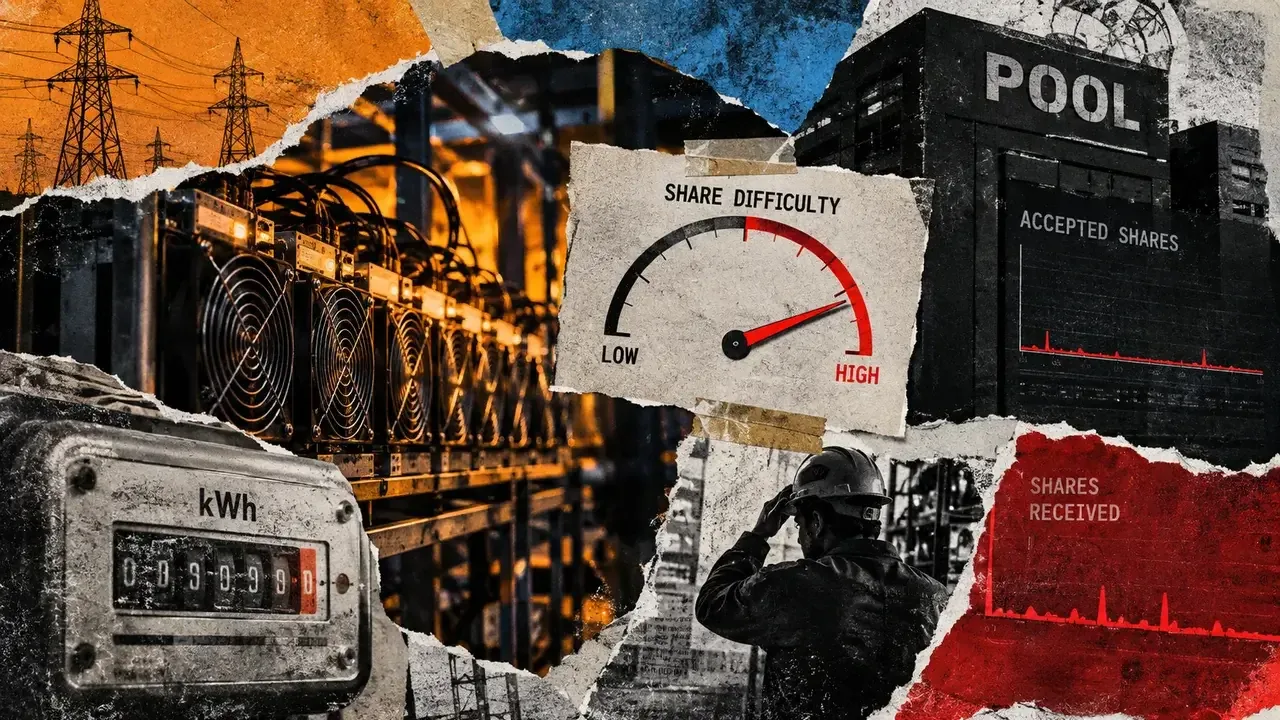
The Counterintuitive Reality of Bitcoin Mining and Power Cycles
A recent report highlights a surprising and counterintuitive dynamic within Bitcoin mining: abruptly cutting power to mining rigs doesn't necessarily save energy, and can, in some cases, actually increase overall consumption. This stems from the way Application-Specific Integrated Circuits (ASICs) – the specialized hardware used for Bitcoin mining – operate when subjected to sudden power interruptions.
How Power Cycling Impacts Mining Efficiency
When Bitcoin miners are abruptly shut down, they don’t simply stop. Instead, they enter a state where they continue to hash, attempting to find valid blocks, but with a significantly reduced chance of success. This is due to the nature of the Proof-of-Work consensus mechanism. The machines continue to run through a 'finite window' attempting to submit shares, but with limited connectivity and processing power, these shares are often rejected. This process consumes energy without contributing meaningfully to block creation.
Key Implications and Technical Details
- Share-Triggered Controllers: The issue is exacerbated by share-triggered controllers, which are designed to keep machines hashing even when disconnected from the main network.
- Inefficient Hashing: The continued hashing in a disconnected state is largely unproductive, representing wasted energy.
- Restart Costs: Fully restarting a mining rig also consumes energy, adding to the overall impact of a power interruption.
Market Impact Analysis
This revelation has several potential implications for the Bitcoin network and the broader cryptocurrency market. Firstly, it challenges the narrative that simply shutting down mining operations is a straightforward solution to concerns about Bitcoin’s energy consumption. Secondly, it highlights the need for more sophisticated power management strategies within mining facilities. This could lead to increased investment in smart power controllers and optimized shutdown procedures. The impact on Bitcoin’s price is likely to be minimal in the short term, but a broader understanding of energy efficiency within mining could improve the long-term sustainability narrative surrounding the asset.
Outlook: Towards Sustainable Bitcoin Mining
The findings underscore the importance of a nuanced approach to addressing Bitcoin’s energy footprint. Simply cutting power isn't a panacea. Instead, the focus should be on incentivizing miners to utilize renewable energy sources, improve hardware efficiency, and implement smart power management systems. Further research into optimal shutdown procedures and the development of more efficient mining hardware will be crucial for mitigating the environmental impact of Bitcoin mining and ensuring its long-term viability. The industry will likely see a move towards more granular control over mining operations, prioritizing efficient power cycling and potentially exploring alternative consensus mechanisms that require less energy.
Market context
Market data reflects conditions at publication time and is not updated in real time.
Data captured at: Sep 21, 2026 22:45 (Tehran)
Likely market impact
| Segment | Outlook |
|---|---|
| Bitcoin | ● Neutral |
| Ethereum | ● Neutral |
| Altcoins | ● Neutral |
| Short term | ● Neutral |
| Long term | ▲ Positive |
Spot prices at publication
Fear & Greed Index
Chart
Source: CryptoSlate