

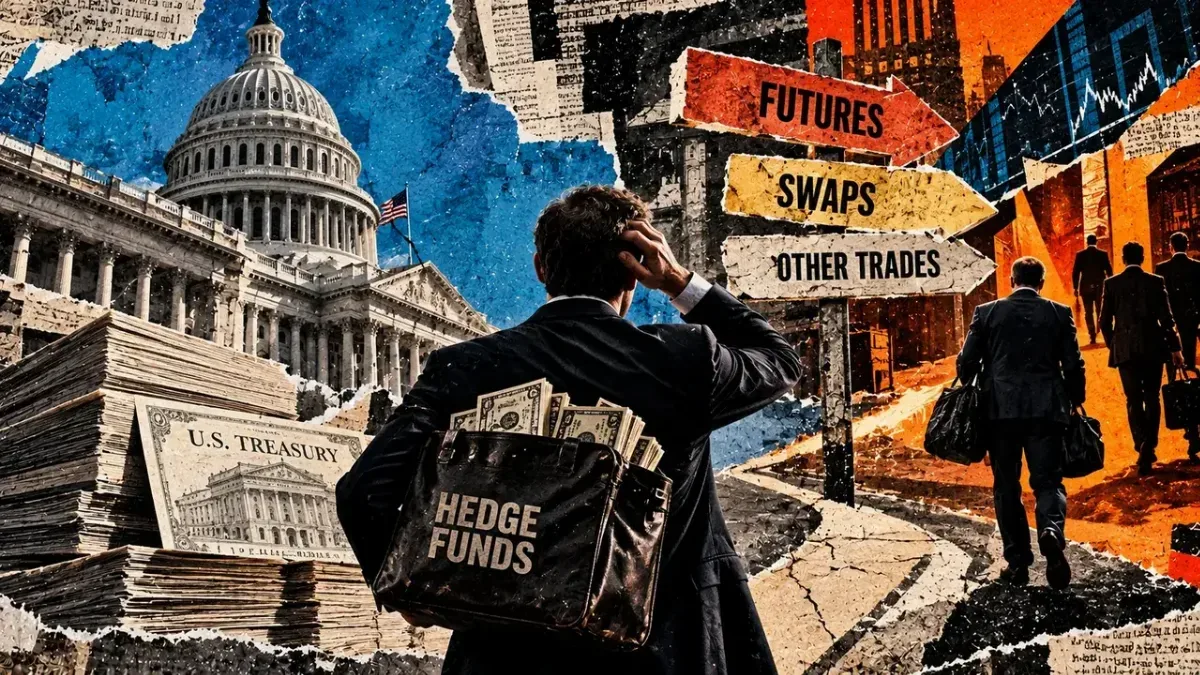
The Basis Trade Machine
Office of Financial Research data shows hedge funds accumulated an estimated $2 trillion in cash U.S. Treasuries by the end of 2025, roughly 7% of all marketable debt outstanding. The buying isn't a bet on yields — it's the long leg of a basis trade. Funds purchase Treasuries while simultaneously selling futures or swaps against them, capturing the spread between cash and derivative prices. With leverage often running 10x to 50x, the strategy turns tiny price discrepancies into meaningful returns on equity.
Why It Matters for Crypto Markets
These trades have become a primary source of marginal demand for Treasuries, but they're also a concentrated source of fragility. When funding costs spike or volatility forces deleveraging, funds must unwind both legs at once — selling Treasuries and buying back futures. That dynamic can trigger a dash for cash that spreads across asset classes. In March 2020, a basis trade unwind helped fuel a 50% Bitcoin drawdown in days as prime brokers pulled leverage across the board.
Unwind Risk Grows With Size
At $2 trillion, the notional exposure dwarfs the $400 billion peak seen before the 2020 stress. The Federal Reserve's standing repo facility and primary dealer backstops exist, but they address dealer balance sheets, not hedge fund redemptions directly. A disorderly unwind would likely hit crypto first: perpetual funding rates would flip negative, basis on CME Bitcoin futures would widen, and stablecoin redemptions could accelerate as cash-seeking investors exit risk.
Market context
Market data reflects conditions at publication time and is not updated in real time.
Data captured at: Oct 25, 2026 16:49 (Tehran)
Likely market impact
| Segment | Outlook |
|---|---|
| Bitcoin | ▼ Negative |
| Ethereum | ▼ Negative |
| Altcoins | ▼ Negative |
| Short term | ▼ Negative |
| Long term | ● Neutral |
Spot prices at publication
Fear & Greed Index
Chart
Source: CryptoSlate